
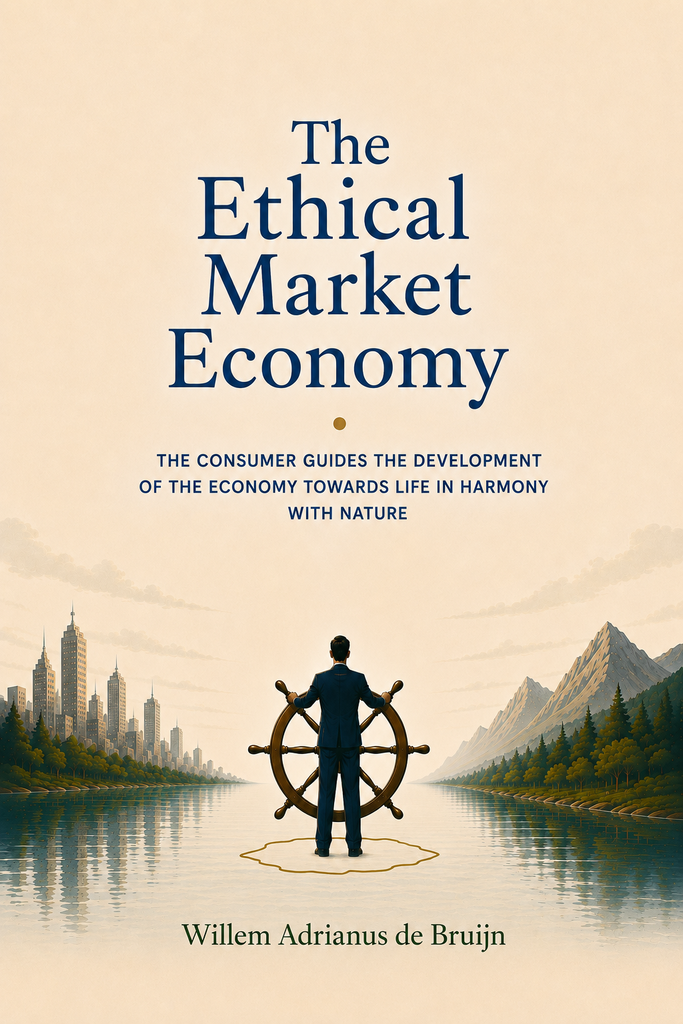
Every day, billions of consumers spend their money to sustain their way of life.
The money consumers spend forms one of the largest flows of money in the economy.
That flow has a direction. It is the direction in which the economy develops.
Every purchase is the result of a choice. Every choice determines which goods and services producers will make.
The consumer is the Pilot of the free-market economy because every choice determines the direction in which the economy develops. A Pilot guides large ships safely into and out of the harbour.
Responsibility
With the role of Pilot of the economy comes the consumer’s responsibility in the free market economy.
The consumer has to sustain the development of the economy while safeguarding the integrity of Nature for this and future generations.
This responsibility arises from the function of the consumer in the operation of the free market economy. Consumers absorb the goods and services offered on the market through the purchases they make. Without consumers removing that output from the market, production comes to a standstill. The COVID pandemic clearly illustrated the importance of consumer purchases. As consumers bought less, production declined.
In today’s economy the consumer cannot fulfil his responsibility to guide the economy towards safeguarding the integrity of Nature because the present economy gives him no financial interest in doing so.
The consumer acquires the power to guide the economy the moment his financial interest coincides with his responsibility as Pilot of the economy. To guide the economy, the consumer needs to receive the Pilot’s Wage.
The Pilot’s Wage
The Pilot’s Wage is the mechanism that gives every consumer a direct financial incentive to choose goods and services with the highest ecological value.
The mechanism is simple.
Every good and every service possesses an ecological value. This equals the percentage of its production costs spent on renewable resources.
The higher the ecological value of a product, the higher the Pilot’s Wage the consumer receives, because the Pilot’s Wage is one third of that ecological value.
Suppose a shirt costs €120 and fifty percent of its production costs have been spent on renewable resources. The shirt’s ecological value is fifty percent of €120, thus €60. The Pilot’s Wage is one third of that ecological value. The consumer therefore pays €20 less for the shirt.
Consumers therefore acquire a financial interest in buying goods and services with the highest ecological value. It is in the interest of the producer to satisfy this demand.
With the Pilot’s Wage, the consumer can pursue his own interest in a way that coincides with society’s interest in living in harmony with Nature. One simple mechanism aligns the interests of consumers, producers and society.
Scientific Foundation
This mechanism is based on three concepts in economics.
The first is the responsibility of the consumer. This has been explained in the previous chapter, Responsibility.
Another is the purpose of the development of the economy.
The economy develops in the direction created by consumers’ spending.
The goal pursued by consumers while spending their money determines the purpose of the development of the economy.
This goal becomes the goal of producers. The pursuit of this shared goal gives purpose to economic development.
The third concept, the efficient use of resources, will be presented later in the chapter Long-term Consequences.
The Economic Service Rendered by the Consumer
Every economic activity that requires people to invest their own money in achieving a common objective must provide a return on that investment, otherwise people will not invest.
The consumer earns the Pilot’s Wage while buying goods and services with the highest ecological value because, by choosing them, he guides the development of the economy so that it stays within the limits of Nature. The Pilot’s Wage is the return the consumer receives for pursuing the common goal of living in harmony with Nature.
It is a wage earned for performing an essential economic service for society.
The Pilot’s Wage reveals that Adam Smith’s Invisible Hand is the hand of the consumer. Consumers steer the economy with the choices they make. The Pilot’s Wage rewards those choices and thus gives that hand a destination: to safeguard the integrity of Nature.
The funds needed to pay the consumer
The Pilot’s Wage can be funded with the capital that states use to repair the damage to the Earth caused by mankind’s current lifestyles.
As consumers increasingly choose products with the highest ecological value, they progressively leave the environment in a better state. The money currently spent on repairing environmental damage becomes available.
Governments can gradually transfer this capital to consumers in order to reward them for choosing products that preserve the quality and state of the environment.
The Pilot’s Wage will not be a burden on the state because the total amount paid to consumers will be less than the money currently spent on repairing environmental damage. Preventing damage is less costly than repairing it.
The money is available. The consumer can therefore fulfil his responsibility by keeping the development of the economy within the limits of Nature. He will be driven by personal and financial interests, two powerful drives in human behaviour, to do so once he receives the Pilot’s Wage. Paying the Pilot’s Wage puts the Ethical Market Economy into motion.
The Ethical Market Economy
Imagine entering a market where every purchase leaves Nature untouched.
Every product contributes to preserving the world in which you live.
Every time you buy, you receive your Pilot’s Wage.
That is the Ethical Market Economy.
You live in harmony with Nature.[1]
The producer deducts the Pilot’s Wage directly from the purchase price.
The state compensates the producer for the amount of the Pilot’s Wage paid.
Producers do not have to identify the recipient of the Pilot’s Wage in their accounting, because they can justify the amount they claim from the state by the ecological value of the merchandise they sold.
This amount is equal to one third of the total ecological value of their sales.
It is thus also equal to one third of the ecological value of all the products sold on the market.
By paying the Pilot’s Wage, the state automatically knows the ecological value of every purchase.
The Pilot’s Wage is a net wage, free from all charges or deductions.[2]
Taking back a part of this wage, e.g., as income taxes, could increase environmental costs, because the consumer might be less motivated to buy products with the highest ecological value. Taxing the Pilot’s Wage is counterproductive. It would be like wanting money back from the baker because his croissants are delicious.
How the Consumer Changes the Purpose of Large Flows of Money in the Ethical Market Economy
The consumer turns the costs of repairing environmental damage into income for preserving the quality and state of the environment.
The consumer keeps environmental costs negligible.
[1] Merriam Webster, Meaning of nature https://www.merriam-webster.com/dictionary/nature
[2] Merriam Webster, definition of “Net” (Entry 3 of 5) https://www.merriam-webster.com/dictionary/net
Interest of the Producer in the Ethical Market Economy
Immediate interests
A large demand
In the Ethical Market Economy, consumers demand goods and services that allow them to live in balance with the needs of Nature.
All consumers will eventually be driven to spend all their money only on products that leave the physical world around them unspoiled.
A permanent demand
Once products with the highest ecological value have become the norm, consumers will continue buying them throughout their lives.
Medium term interest
Ecological goods and services are still relatively scarce. Research is needed to create them. Considerable investment in research will be needed to set the economy on the path to living in harmony with Nature.
Long term interest
By keeping natural resources intact in order to satisfy consumer demand, producers sustain the sound condition of their working capital, because natural resources constitute that capital.
Ethical basis of the economy
When producers offer their merchandise in the Ethical Market Economy, they give an ethical basis to the economy. Economics is then no longer defined as the science of sharing limited resources to satisfy unlimited demands, but as the science of sharing limited resources to satisfy all natural demands.
Definitions from Oxford Languages
Natural
1. existing in or derived from nature; not made or caused by humankind.
“carrots contain a natural antiseptic”
2. in accordance with the nature of, or circumstances surrounding, someone or something.
“sharks have no natural enemies”
Consequences of the Ethical Market Economy
Immediate consequences
Splitting of the socio-economic power
When consumers spend money in the Ethical Market Economy, the socio-economic power is divided into two distinct powers: the social power of income of the producer and the economic power of expense of the consumer.
The producer gives shape to society. Everything we see around us exists because producers earn an income by creating it. The income producers earn gives them considerable influence over the development of society.
With the economic power of expense, consumers can live well in flourishing surroundings by choosing products whose ecological value has been scientifically demonstrated by producers. They must prove every claim they make about that ecological value.
With the economic power of their combined expenses, consumers can safeguard the sound condition of Nature.
Ethical currents in the economy
In the Merriam-Webster dictionary, integrity is defined as:
1: firm adherence to a code of especially moral or artistic values : INCORRUPTIBILITY
2: an unimpaired condition : SOUNDNESS
3: the quality or state of being complete or undivided : COMPLETENESS
Since integrity means both soundness and moral values, the integrity of anything can be maintained only with integrity.
With their economic power of expense, consumers will maintain ethical currents in the economy because their personal and financial interests coincide with safeguarding the integrity of Nature.
The social power of income of producers and the economic power of expense of consumers will work together in a dynamic equilibrium that maintains the integrity of Nature.
Long term consequences
Efficient Use of Resources
The last of the three concepts in economics presented in the chapter Scientific Foundation is the principle of using resources efficiently.
Optimum efficiency in the use of resources is achieved when costs are managed at the source of the income that covers those costs.
This principle implies that the person who earns the income should manage the costs paid from that income in order to use resources as efficiently as possible.
Producers have proven this concept to be correct. They deduct their production costs from the revenue generated by selling the goods and services they produce.
The money producers spend on resources forms part of their costs of production. Producers therefore maximize the difference between revenues and costs—their profits—by maintaining optimum efficiency in the use of resources in their production processes.
Consumers earn an income and spend part of it to maintain their way of life. This expenditure represents their costs of living. To achieve optimum efficiency in the use of resources, consumers must manage their costs of living with optimum efficiency in mind.
In the Ethical Market Economy, consumers spend their money only on goods and services with the highest ecological value and therefore the highest efficiency in the use of resources.
No Poverty and Peace
Demand for products with the highest ecological value, and therefore the highest efficiency in the use of resources, could quickly reduce the amount of resources needed to satisfy human demand.
Any increase in the efficiency with which billions of consumers use resources means that so much more is produced from the same input that there will be enough for everyone on Earth to live decently.
There will be no more poverty. People will share comparable levels of well-being. People who share contentment live in peace.
This will be especially true when consumers have achieved optimum efficiency in the use of resources in their daily lives. Peace might then be permanent.
Conclusion
Our civilisation still has time to change the course of its history by living within the limits of Nature.
The Ethical Market Economy shows how.
The mechanism is simple.
And now,
you tell me.
The Ethical Market Economy is available from Amazon.
The Ethical Market Economy can be set into motion.
Why is this not done?
Read Why Not?